
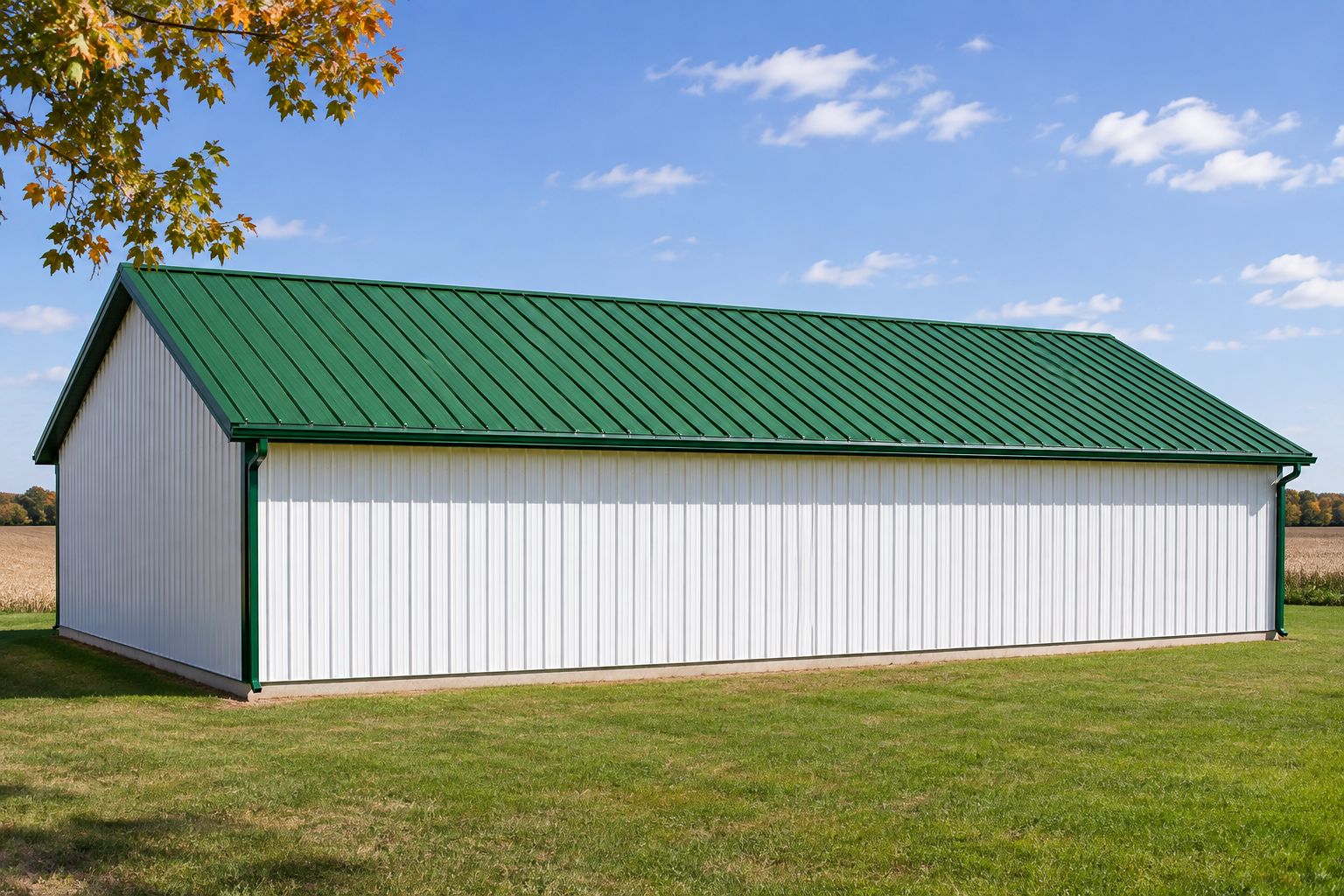
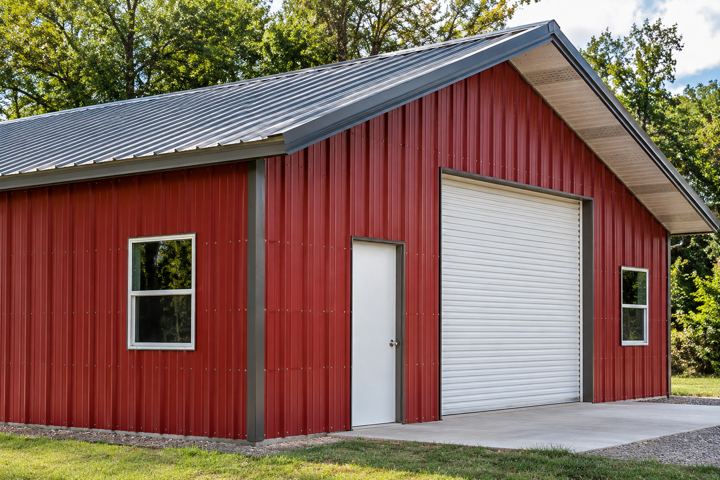
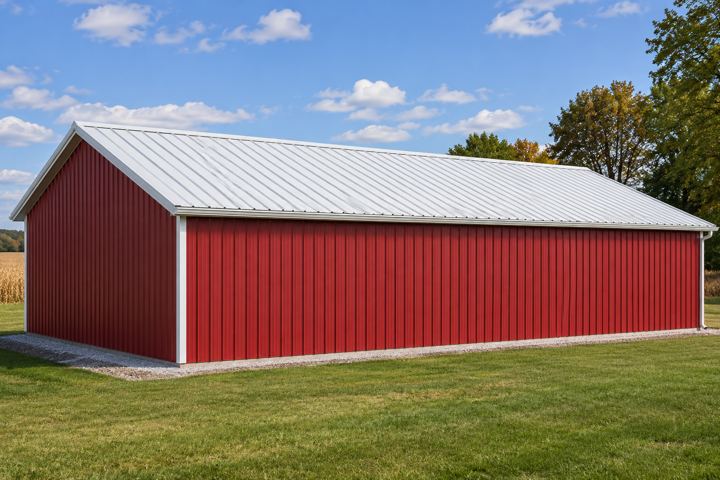
Five common profiles
Rib shape is what separates them. Taller, wider ribs carry a panel across wider purlin spacing and keep water moving on flatter roofs.
| Profile | Width covered | Rib | Gauges | Pitch, as low as | Seen on |
|---|---|---|---|---|---|
| R-panel / PBR | 36″ | 1¼″ trapezoid every 12″ | 24, 26, 29 | ½:12–1:12 with sealed side laps | Metal buildings, farm and commercial roofs and walls |
| Ag rib | 36″ | About ¾″, roughly every 9″ | 26, 29 | 2½:12–3:12 | Houses, barns, sheds, garages |
| 5V-crimp | 24″ | Five V-shaped ribs | 24, 26, 29 | 3:12 | Farmhouses, coastal and traditional homes |
| ⅞″ corrugated | About 32″–35″ on a roof | ⅞″ rounded wave, about 2⅔″ apart | 24, 26 | 1:12–3:12, by maker | Industrial and commercial roofs and walls |
| ½″ corrugated | About 21″–24″ | ½″ wave, 2½″ apart | 26, 29 | 3:12 | Farm buildings, rustic or modern houses |
Each manufacturer rolls its own version, so widths, gauges and pitch limits move around. The exact numbers for your panel come on the quote.
What most metal buildings wear. It can bridge open purlins and handle very low slopes. PBR adds a bearing leg on one edge so the side lap sits on the purlin.
Lower ribs, lower price. A favorite for re-roofing houses over plywood and for barns and garages.
A traditional look with five flat-topped V's per sheet. Installed over solid decking.
The old-school wave. ⅞″ for commercial work, ½″ for barns, wainscot and accent walls.
Gauge in brief
Gauge runs backwards: 29 is the thinnest of the common panels, 22 the heaviest.
| Gauge | Roughly | Where it goes |
|---|---|---|
| 29 | 0.014″ | Houses, barns, light-duty buildings |
| 26 | 0.018″ | Houses and light commercial, windier areas |
| 24 | 0.024″ | Commercial and industrial, wider purlin spacing |
| 22 | 0.030″ | Heavy commercial and industrial |
Heavier steel resists dents and spans farther, at more weight and cost. Code or a wind rating can set the floor. More in steel gauge, in plain numbers.
Coatings and paint
- Galvanized: a zinc coat. Inexpensive and tough, typical on farm buildings.
- Bare aluminum-zinc: an aluminum-zinc coat that generally outlives zinc alone, with a bright silver finish.
- SMP: silicone-modified polyester, the standard painted panel.
- PVDF: fluoropolymer paint that holds color longest. The usual choice for architectural and commercial jobs.
- Specialty: wood-grain and rust-look prints, matte, textured and metallic colors.
Paint warranties typically run from 20 to 40-plus years depending on the paint system. Your order's warranty sits in your account.
On the job
- Panels go over plywood or OSB, or straight across wood or steel purlins.
- Over a solid deck, lay synthetic or high-temperature underlayment first.
- Screws with sealing washers go in the flat or through the rib, whichever the panel maker calls for. Use painted heads on painted steel.
- Profiled foam closures fill the rib gaps at eaves and ridges; matching trim closes every edge.
- Going over an old shingle roof? Many codes permit it over a single layer, usually on battens or spacers. Confirm with the local building department.
The panel maker's install instructions govern.
Questions we hear
Exposed screws or standing seam?
Screws cost less and go faster but need checking over the years. Standing seam hides its fasteners and costs more. See exposed-fastener or standing seam?
What's the service life?
Usually 30 to 40-plus years. Coating, climate and upkeep decide where in that range a roof lands.
Will rain be loud?
Over a solid deck and underlayment, hardly louder than any other roof. An uninsulated pole barn is a different story.
And hail?
Big hail dents any metal. Heavier gauges hold up better, and some panels are rated Class 4 under UL 2218.
How often do screws get replaced?
Plan on looking at them every 10 to 20 years and swapping any with worn washers.
Can I cut panels on site?
Yes, with snips or a shear. Skip abrasive blades; the hot filings rust on the paint.