
Five systems
| System | Seam | Panel | Gauges | Lowest typical pitch | How it's held | Typical job |
|---|---|---|---|---|---|---|
| Snap-lock | 1″–1¾″ | 12″–18″ | 24, 26 | 3:12 | Clips or a nail flange; the next panel snaps on | Houses and light commercial over plywood |
| Nail-strip | 1″–1½″ | 12″–16″ | 24, 26 | 3:12 | Screws in a slotted flange the next panel hides | Houses, porches, accent roofs |
| Mechanical, single lock | 1½″–2″ | 12″–18″ | 22, 24 | 1:12–2:12 | Clips; seamer folds the seam 90° | Long runs, houses and commercial |
| Mechanical, double lock | 2″ | 12″–18″ | 22, 24 | ½:12 or flatter | Clips; seam folded 180° twice | Low-slope commercial, high-wind sites |
| Structural | 2″–3″ | 16″–24″ | 22, 24 | ¼:12–½:12 | Clips on open purlins, no deck | Warehouses and metal buildings |
Every maker's version differs a little in size, gauge and pitch limit. Your quote spells out the exact system.
The usual residential pick. Panels click together by hand, so no seaming tool is involved.
Same look, but each panel screws down through a slotted flange. Budget-friendly; thermal movement keeps panel runs shorter.
Folded shut with a hand or power seamer once the panels are down. Double lock gives the tightest joint and suits very flat roofs.
Deep ribs strong enough to span steel purlins with nothing underneath. Standard on warehouses and plants.
Thermal movement
A long steel panel can grow and shrink noticeably between a cold night and a hot afternoon. Fixed clips pin a panel in place and are fine on short runs. Floating clips let the panel slide lengthwise while holding it down, so seams and fasteners aren't strained. Long and commercial runs generally call for floating clips.
Oil canning
Sometimes the flat between seams shows a slight ripple, most visible in low, raking light. It's cosmetic only. To keep it down:
- Choose a panel with pencil ribs or striations in the flat.
- Go narrower, or a gauge heavier.
- Start from a flat, true deck and don't overtighten the clips.
Finishes
PVDF paint is standard on most standing seam for its long color life. SMP, bare aluminum-zinc, matte and metallic options are common too. Aluminum panels suit coastal sites; copper and zinc are available for architectural work. Paint warranties of 30 to 40-plus years are typical; yours is in your account.
On the job
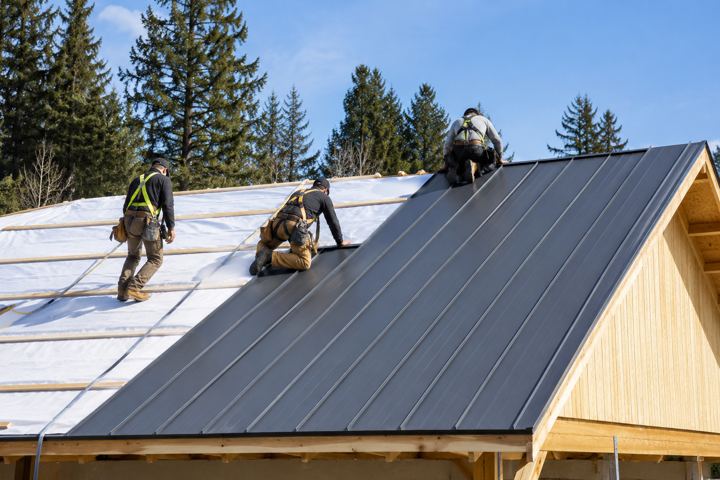
- Snap-lock, nail-strip and most mechanical systems need a solid plywood or OSB deck.
- High-temperature synthetic underlayment goes underneath and is frequently required.
- Each system has its own eave, rake, ridge and valley trim, so order trim built for that system.
- Panels are usually formed to each run's exact length; extra-long ones may need special freight or forming on site.
The system maker's install instructions govern.
Questions we hear
Is it worth paying more for?
Hidden fasteners mean fewer places to leak and less to maintain, and it looks sharper. On a building you'll keep, most owners think so.
Can it go on a flat-ish roof?
Mechanical and structural systems can, some to ½:12 or even ¼:12. Snap-lock and nail-strip want 3:12.
Do I need a seamer?
Only for mechanical seam.
Snow guards and solar?
Both attach with clamps that grip the seam, with no holes through the roof.
How long does it last?
With a good paint system and a proper install, 40 years or more is typical.