
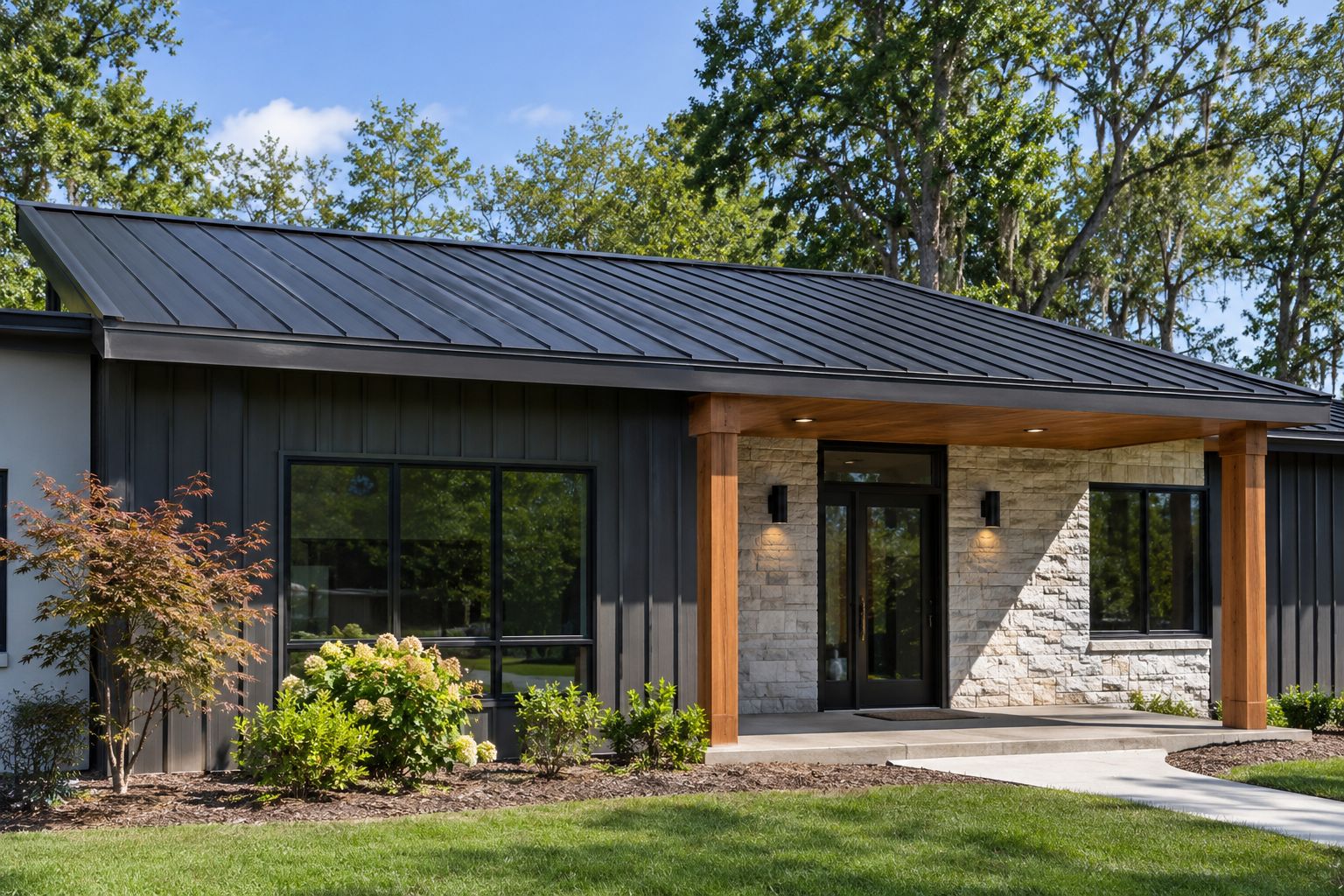
Side by side
| Screw-down | Standing seam | |
|---|---|---|
| How it's attached | Washered screws driven through the panel face | Clips or a nail flange tucked under the seam |
| Appearance | Ribs with lines of screw heads | Smooth pans between raised seams |
| Usual gauges | 29, 26 or 24 | 26, 24 or 22 |
| Flattest typical pitch | ½:12 to 3:12, depending on profile | ¼:12 to 3:12, depending on system |
| Expansion and contraction | Restricted, since the screws pin the panel | The clips let the panel slide |
| Maintenance | Inspect screws and replace worn ones every 10–20 years | Very little on a routine basis |
| Price of materials | Lower | Higher |
| Installation | Quicker and simpler | Takes longer; mechanical seams need a seaming tool |
These are common ranges. Each product's own numbers govern.
Where screw-down makes sense
- Barns, shops, garages and storage sheds
- Metal buildings with open purlins
- Re-roofs on a tight budget
- Wall panels, where the screws are less noticeable
Where standing seam makes sense
- Houses where the look counts
- Shallow roofs, since the tall seam sits above the water
- Long panel runs, where expansion really adds up
- Owners who'd rather not maintain the roof
- Roofs that will carry snow guards or solar, which clamp to the seam with no holes
Thinking long term
Screw-down wins on day one. Across 40-plus years, though, it needs its screws checked and some replaced, and that's paid labor. Standing seam starts higher but has far fewer places to leak and needs less care. On a building you plan to keep, weigh the cost over its whole life rather than the opening price.
The profiles in each family are on metal roof and wall panels and standing seam.