
- Aluminum-zinc coating
- A metal coat of aluminum and zinc applied to steel to keep it from rusting. Left bare or painted over.
- Architectural shingle
- An asphalt shingle built from two or more bonded layers, so the roof has depth and shadow lines. Also called dimensional or laminated.
- Batten
- A wood or metal strip run across the roof as a nailing base for tile or metal panels.
- Butyl tape
- Sticky sealing tape that never fully cures, laid in panel overlaps and trim seams.
- Cap nail
- A roofing nail fitted with a broad plastic washer, for fastening synthetic underlayment.
- Class 4
- The top impact class in UL 2218: the product survives a 2″ steel ball dropped from 20 feet.
- Class A
- The best fire classification a roof covering can earn.
- Clip
- A bracket under a standing seam panel that holds it down but lets it slide as it expands.
- Closure strip
- A foam or rubber filler shaped to match a panel's ribs, sealing the openings at the eave and ridge.
- Concealed fastener
- A screw or nail covered by the next panel or a seam, so it can't be seen. Standing seam works this way.
- Cover board
- A stiff board placed over the insulation of a flat roof to protect it and give the membrane a solid base.
- Cricket
- A small ridged section built on the high side of a chimney or curb to divert water around it.
- Cut list
- The list of panel lengths and how many of each, used to order panels run to length.
- Deck
- The plywood or OSB sheathing the roof is built on.
- Double lock
- A mechanical seam folded over twice (180°), the tightest seam for shallow roofs. A single lock is folded once (90°).
- Drip edge
- Metal at the roof edge that kicks water out past the fascia.
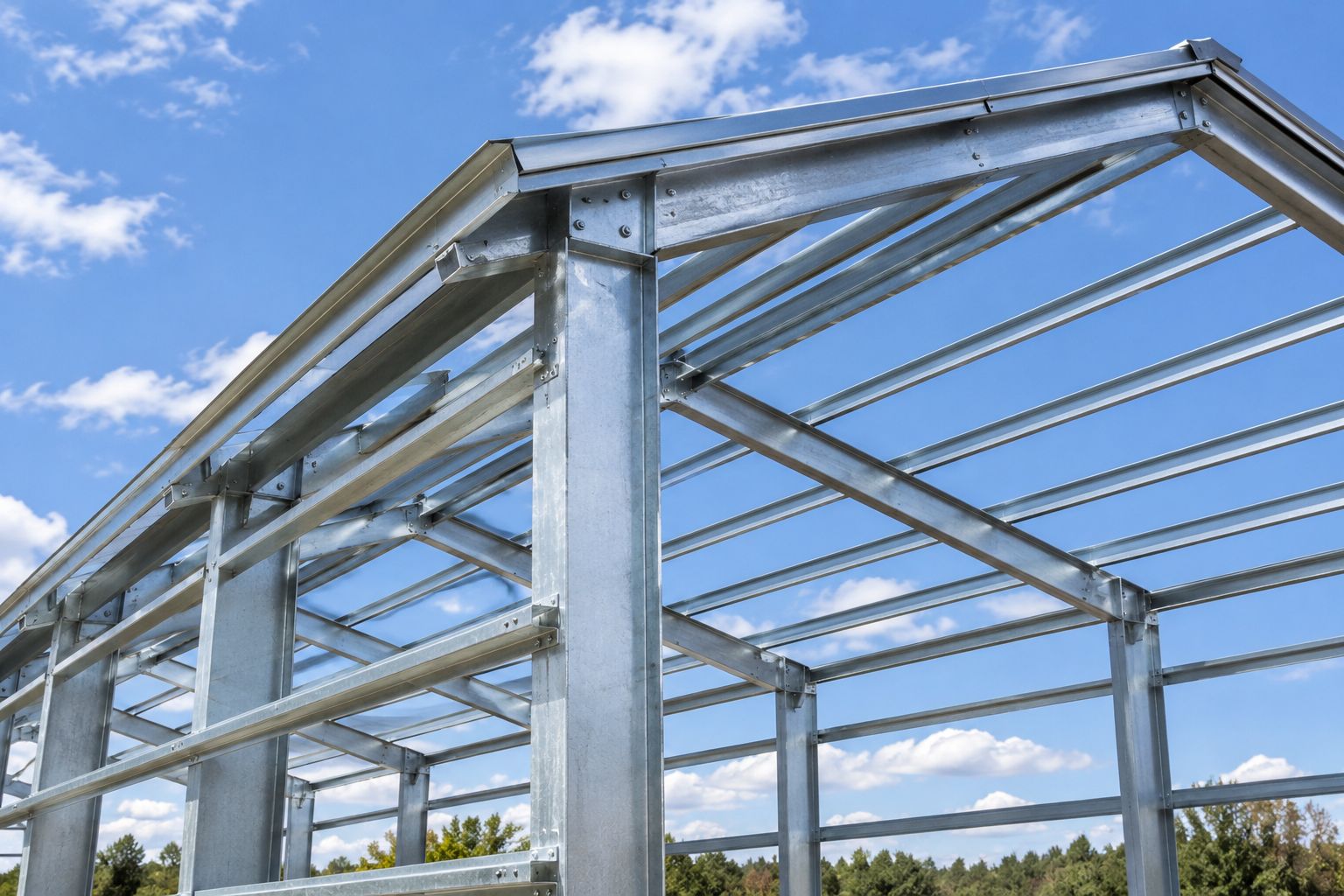
- Eave strut
- The steel member with a sloped top that joins the roof and wall of a metal building.
- EPDM
- Rubber roofing membrane for flat and low-slope roofs.
- Exposed fastener
- A screw driven through the face of the panel, left in view.
- Flashing
- Bent metal or membrane that seals seams, edges and openings.
- Gable
- The triangle of wall at the end of a pitched roof.
- Galvanized
- Steel with a zinc coating for rust protection.
- Gauge
- The number used for sheet metal thickness. It runs backwards: the lower it is, the thicker the steel.
- Girt
- A horizontal member on a metal building's wall that the wall panels attach to.
- Girth
- How wide a strip of metal a trim piece takes before it's bent.
- Hat channel
- Steel furring bent into a hat shape, used for furring or as a light purlin.
- Hem
- An edge folded back flat on itself, stiffer and safer to handle.
- Hip
- The outside corner where two sloped roof faces meet.
- Low-slope roof
- Any roof at 3:12 pitch or flatter.
- Mil
- A thousandth of an inch, the unit for membrane thickness.
- Net free area (NFA)
- How much open area a vent actually has, the figure used to size attic venting.
- Oil canning
- A wavy look in the flat part of a metal panel.
- Pitch
- Rise over a 12-inch run, written as a ratio such as 4:12.
- Polyiso
- Polyisocyanurate foam board, the usual insulation on commercial flat roofs.
- Purlin
- A horizontal roof member the panels screw into.
- PVDF
- Fluoropolymer paint, the top-tier finish for holding color.
- Rake
- The sloping roof edge at a gable end.
- Ridge
- The top line of the roof, where two faces meet.
- SMP
- Silicone-modified polyester, the standard everyday paint on metal.
- Square (SQ)
- 100 sq ft of roof.
- Standing seam
- Metal roofing with raised, interlocking seams and no exposed screws.
- TPO
- Thermoplastic single-ply membrane, usually white, with seams welded by heat.
- Underlayment
- The water-shedding sheet laid on the deck beneath the roofing.
- Valley
- The inside corner where two sloped roof faces meet.